
New technologies demand new insights.

Issuing crypto-assets
a framework
for growth
of view:
Track record.
-
Advised on 10+ MiCA licensing processes with the AFM.
-
Established and structured 50+ crypto businesses.
-
Advised 25+ directors on AFM or DNB fit and proper assessments.
-
Set the standard for asset segregation by CASPs.

Here’s our point of view:
We can help you prepare for what the future holds for your business.
Issuing a crypto-asset in the European Union can trigger a distinct regime under the Markets in Crypto-Assets Regulation (MiCA), even where the issuer itself is not providing crypto-asset services.
MiCA distinguishes between three main types of crypto-assets: Asset-Referenced Tokens (ART), E-money Tokens (EMT), and crypto-assets other than ARTs or EMTs. ARTs and EMTs are together referred to as stablecoins. The category ‘crypto-assets other than ART or EMT’ is designed as a catch-all category, covering all non-stablecoin crypto-assets.
For crypto-assets other than ARTs or EMTs, MiCA focuses in particular on the offer to the public, the admission to trading on a trading platform, the crypto-asset white paper, and related obligations on marketing communications, conduct and disclosure. These aspects are governed by Title II of MiCA. More information on stablecoins can be found here.
In practice, the first question is rarely whether a white paper is needed. The real starting point is whether the relevant crypto-asset falls within Title II of MiCA, or whether it should instead be analysed under another framework, such as the regime for ARTs or EMTs, or outside MiCA altogether. This all depends on the specific qualification of the crypto-asset.
Are you preparing to issue a crypto-asset, assessing whether a white paper is required, or determining whether your token falls within Title II of MiCA? We are happy to help you qualify the crypto-asset, identify the applicable regime and determine the next steps for your issuance. Contact Willem-Jan Smits or Rens Kattenbelt to schedule an introductory call.
Qualification of crypto-assets.
What is the definition of a crypto-asset?
Crypto-assets are defined in MiCA as a digital representation of a value or of a right that is able to be transferred and stored electronically using distributed ledger technology or similar technology.
Which crypto-assets are not regulated by MiCA?
MiCA aims to create a catch-all regulatory framework. This means that the aim is to regulate crypto-assets that are not yet regulated by other regulatory frameworks. As such, MiCA’s scope is, in addition to the definition of crypto-assets set out above, primarily determined by the various exemptions included in the regulation.
Meeting the definition of a crypto-asset under MiCA does not automatically imply that the crypto-asset falls under MiCA’s scope. For example, MiCA does not apply to crypto-assets that qualify as one or more of the following:
- Financial instruments.
- Deposits, including structured deposits.
- Funds, except if they qualify as EMT.
- Securitisation positions.
- Non-life or life insurance products falling within the classes of insurance listed in Annexes I and II to the Solvency II Directive, or reinsurance and retrocession contracts referred to in that Directive.
- Various pension products and social security schemes covered by national or European law.
Furthermore, MiCA does not apply to crypto-assets that are unique and not fungible with other crypto-assets. These are the so-called non-fungible tokens (NFTs). Examples of this category of crypto-assets are digital art and collectibles. The value of such unique and non-fungible crypto-assets is attributable to each crypto-asset’s unique characteristics and the utility it gives to the holder of the crypto-asset. The fractional parts of a unique and non-fungible crypto-asset should not be considered unique and non-fungible. The issuance of crypto-assets as non-fungible tokens in a large series or collection should be considered an indicator of their fungibility. The mere attribution of a unique identifier to a crypto-asset is not, in and of itself, sufficient to classify it as unique and non-fungible. The assets or rights represented should also be unique and non-fungible in order for the crypto-asset to be considered unique and non-fungible.
What kind of crypto-assets does MiCA regulate?
MiCA aims to create a catch-all regulatory framework. This means that the aim is to regulate crypto-assets that are not yet regulated by other regulatory frameworks. As such, MiCA’s scope is, in addition to the definition of crypto-assets set out above, primarily determined by the various exemptions included in the regulation.
MiCA distinguishes between three main types of crypto-assets: ARTs, EMTs, and crypto-assets other than ARTs or EMTs. ARTs and EMTs are together referred to as stablecoins. The category ‘crypto-assets other than ARTs or EMTs’ is designed as a catch-all category, covering all non-stablecoin crypto-assets. More information on stablecoins can be found here.
As an additional category, MiCA specifically defines utility tokens. ‘Utility token’ is a term that has been broadly used in the crypto sector. However, MiCA applies a strict definition to utility tokens. Utility tokens are a type of crypto-asset that is only intended to provide access to a good or a service supplied by its issuer. This definition is important for one of the exemptions to Title II of MiCA set out below.
Title II of MiCA provides the requirements applicable to offers to the public, or admissions to trading, of crypto-assets other than ARTs or EMTs. These requirements concern the following subjects:
- The person making an offer to the public or seeking admission to trading of a crypto-asset must be a legal person.
- A crypto-asset white paper must be drawn up, notified and published.
- Marketing communications must comply with specific requirements set out in Article 8 MiCA.
- Marketing communications must be published in accordance with specific requirements set out in Article 9 MiCA.
- The person making an offer to the public or seeking admission to trading of a crypto-asset must adhere to specific requirements set out in Article 14 MiCA.
Crypto-asset white papers.
Is a white paper required for offering a crypto-asset?
If a crypto-asset falls within the scope of MiCA, the offeror may be required to draw up, notify and publish a crypto-asset white paper.
For crypto-assets other than ARTs or EMTs, a white paper is required if an offeror offers a crypto-asset to the public or admits a crypto-asset to trading. An ‘offer to the public’ is a communication to persons in any form, and by any means, presenting sufficient information on the terms of the offer and the crypto-assets to be offered so as to enable prospective holders to decide whether to purchase those crypto-assets.
However, certain exemptions may apply to the requirements applicable to the offering or admitting to trading of crypto-assets, including to the requirement to draw up, notify and publish a white paper.
What exemptions apply for offers to the public?
White papers do not have to be drawn up, notified and published, and marketing communications do not have to be published, in the following situations:
- The offer is made to fewer than 150 natural or legal persons per Member State where such persons are acting on their own account.
- Over a period of 12 months, starting with the beginning of the offer, the total consideration of an offer to the public of a crypto-asset in the Union does not exceed EUR 1.000.000,-, or the equivalent amount in another official currency or in crypto-assets.
- The offer is addressed solely to qualified investors and the crypto-asset can only be held by such qualified investors.
Furthermore, none of the requirements for offering a crypto-asset to the public apply in the following situations:
- The crypto-asset is offered for free.
- The crypto-asset is automatically created as a reward for the maintenance of the distributed ledger or the validation of transactions (e.g. block rewards).
- The crypto-asset is a utility token providing access to a good or service that exists or is in operation.
- The holder of the crypto-asset has the right to use it only in exchange for goods and services in a limited network of merchants with contractual arrangements with the offeror.
If the offer is exempt on the basis of the ‘limited network’ exemption, the offeror must notify the competent authority when the total consideration of the offer exceeds EUR 1.000.000 during a period within twelve months.
All the exemptions set out above do not apply where the offeror, or another person acting on the offeror’s behalf, makes known in any communication its intention to seek admission to trading of the crypto-asset.
What exemptions apply for admission to trading?
White papers do not have to be drawn up, notified and published in the following situations:
- The crypto-asset is already admitted to trading on another trading platform for crypto-assets in the European Union.
- The crypto-asset white paper is drawn up in accordance with Article 6 MiCA, updated in accordance with Article 12 MiCA, and the person responsible for drawing up such white paper consents to its use in writing.
Requirements for crypto-asset white papers.
What should be included in a crypto-asset white paper?
The crypto-asset white paper is a central disclosure document for the offer or admission to trading of a crypto-asset other than ARTs or EMTs. The crypto-asset white paper shall contain the following information:
- Information about the offeror or the person seeking admission to trading.
- Information about the issuer, if different from the offeror or person seeking admission to trading.
- Information about the operator of the trading platform in cases where it draws up the white paper.
- Information about the crypto-asset project.
- Information about the offer to the public of the crypto-asset or its admission to trading.
- Information about the crypto-asset.
- Information on the rights and obligations attached to the crypto-asset.
- Information on the underlying technology.
- Information on the risks.
- Information on the principal adverse impacts on the climate and other environment-related adverse impacts of the consensus mechanism used to issue the crypto-asset.
In cases where the crypto-asset white paper is not drawn up by the offeror, the person seeking admission to trading, or the operator of the trading platform, the crypto-asset white paper shall also include the identity of the person that drew up the crypto-asset white paper and the reason why that particular person drew it up.
Several key principles govern the drafting of a crypto-asset white paper:
- The crypto-asset white paper should be fair clear and not misleading. It shall not contain material omissions and shall be presented in a concise and comprehensible form.
- The crypto-asset white paper shall not contain any assertions as regards the future value of the crypto-asset.
- The crypto-asset white paper shall contain several predetermined risk warnings.
- The crypto-asset white paper shall contain a statement on compliance by the management body of the offeror, person seeking admission to trading of operator of the trading platform.
- The crypto-asset white paper shall contain a summary.
- The crypto-asset white paper shall be drawn up in an official language of the home Member State and any host Member State, or in a language customary in the sphere of international finance.
Annex I of MiCA clearly sets out all data to be included in the crypto-asset white paper.
Does a crypto-asset white paper require approval?
Crypto-asset white papers that have been drawn up for crypto-assets other than ARTs or EMTs do not need to be approved by the supervisory authority. However, it does need to be notified to that authority. To fully disclose that, crypto-asset white papers are required to contain a clear and prominent statement on the first page, stating: ‘This crypto-asset white paper has not been approved by any competent authority in any Member State of the European Union. The offeror of the crypto-asset is solely responsible for the content of this crypto-asset white paper.’
The supervisory authority for the Netherlands, the AFM, expressly warns against presenting a crypto-asset white paper as ‘MiCA-compliant’. This may be deemed misleading, as it suggests supervisory approval. The AFM also expects crypto-asset white paper submitters to identify the correct home Member State, identify host Member States where relevant, and provide the URL where the crypto-asset white paper will be accessible.
What format should a crypto-asset white paper be in?
Crypto-asset white papers shall be made available in a machine-readable format. The European supervisory authority ESMA has drafted Implementing Technical Standards (ITS) with regard to the forms, formats and templates for crypto-asset white papers. These can be found in our Level 2 and Level 3 measures tracker.
When does a crypto-asset white paper need to be changed?
Offerors, persons seeking admission to trading or operators of a trading platform shall modify their published crypto-asset white papers whenever there is a significant new factor, material mistake or material inaccuracy that can affect the assessment of the crypto-assets. These modified crypto-asset white papers shall be notified to the competent authority of the home Member State at least seven working days before their publication. The public must immediately be informed of the modified crypto-asset white paper. The modified crypto-asset white paper must be timestamped.
Marketing communications.
What requirements apply to marketing communications?
Marketing communications relating to an offer to the public, or the admission to trading of a crypto-asset other than an ARTs or EMTs, must comply with the following requirements:
- The marketing communications must be clearly identifiable as such.
- The information in the marketing communications must be fair, clear and not misleading.
- The information in the marketing communications must be consistent with the information in the crypto-asset white paper.
- The marketing communications must clearly state that a crypto-asset white paper has been published and clearly indicate the website address, telephone number and email address of the offeror, the person seeking admission to trading, or the operator of the trading platform.
- The marketing communications must clearly and prominently state that they have not been reviewed or approved by any competent authority in any Member State of the European Union.
Marketing communications must be published on the publicly accessible website of the offeror or person seeking admission to trading of the crypto-asset. This publication must occur at a reasonable time in advance of, and in any event before the starting date of, the offer to the public or the admission to trading of those crypto-assets.
When may marketing communications be shared?
In the event that a crypto-asset white paper is required, marketing communications may only be shared after the crypto-asset white paper is published.
Do marketing communications need to be notified?
Marketing communications only need to be notified to the supervisory authority of the home Member State and host Member State upon request. Marketing communications do not need to be approved before they are shared.
When do marketing communications need to be changed?
Offerors, persons seeking admission to trading or operators of a trading platform shall modify their marketing communications whenever there is a significant new factor, material mistake or material inaccuracy that can affect the assessment of the crypto-assets. These modified marketing communications shall be notified to the competent authority of the home Member State at least seven working days before their publication. The modified marketing communications must be timestamped.
Right of withdrawal.
What is the right of withdrawal?
MiCA introduces the right of withdrawal for crypto-assets other than ARTs or EMTs. Retail holders who purchase these crypto-assets either directly from an offeror or from a CASP placing crypto-assets on behalf of that offeror have a right of withdrawal. This means that these retail holders have a period of 14 calendar days within which they may withdraw from their agreement to purchase those crypto-assets without incurring any fees or costs and without being required to give reasons. This period begins from the date of the agreement of the retail holder to purchase the crypto-assets.
Our approach.
What is the Watsonlaw approach?
At Watsonlaw, we approach crypto-asset issuance in a practical, pragmatic and hands-on manner. We understand that issuance projects often develop quickly and involve a combination of product, commercial and regulatory decisions that need to fit together from the outset.
Our work usually starts with the legal qualification of the crypto-asset and the proposed issuance or listing strategy. We help clients assess whether the crypto-assets falls within the scope of MiCA, whether stablecoin rules may apply, whether a white paper is required, and how the offer or admission to trading should be structured. From there, we assist with white paper drafting and review, exemption analysis, marketing communications, and interactions with trading platforms, service providers and regulators where relevant.
Our advice is tailored to the structure at hand. Whether you are preparing a token launch, reviewing an existing white paper, assessing a listing strategy or dealing with a more complex tokenisation project, we focus on clear analysis and workable next steps. Our aim is not only to identify the legal framework, but to help clients move forward with a robust and commercially workable issuance structure.
FAQ.
What does ‘seeking admission to trading’ mean in practice?
According to the AFM, this requires a concrete intention to admit the crypto-asset to trading, not merely a theoretical possibility. The specific trading platform should already have been identified and this should be reflected in the white paper.
What are the responsibilities of offerors, persons seeking admission to trading, operators of trading platforms and other CASPs with regard to white papers for crypto-assets other than ARTs or EMTs that were admitted to trading prior to 30 December 2024?
For crypto-assets other than ARTs or EMTs admitted to trading prior to 30 December 2024, offerors and persons seeking admission to trading must only comply with marketing rules. There is no white paper requirement.
Operators of trading platforms must, by 31 December 2027, ensure there is a white paper. They must also publish hyperlinks to any existing (published) white papers.
Other CASPs referenced in Article 66(3) MiCA must only publish hyperlinks to any existing (published) white papers. Where there are no such white papers, they do not have the responsibility to ensure they are produced.
If the crypto-asset is not available on a trading platform, there might not be a white paper for it even after 31 December 2027.
Contact us.
Are you launching a crypto or blockchain-related project, assessing the regulatory treatment of a product or service, or looking for legal advice on a more complex digital finance matter?
Watsonlaw advises on a broad range of crypto- and blockchain-related legal issues, including MiCA, stablecoins, payment services and e-money, investment funds investing in crypto-assets, tokenisation of financial instruments, DeFi-related structures and other innovative business models.
We are happy to assist with the legal qualification of your activities, the structuring of your product or service, the applicable legal framework and the next steps for your business or project.
Would you like to know more? Please contact Willem-Jan Smits or Rens Kattenbelt.
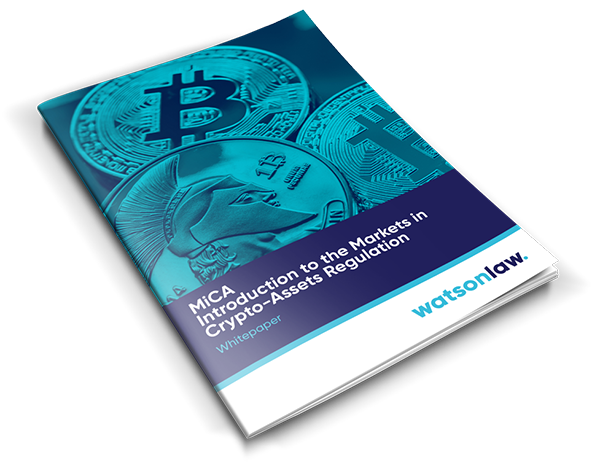
Download the MiCA Whitepaper.
The draft Markets in Crypto-Assets (MiCA) Regulation was released by the European Commission in September 2020. As with most markets-focused regulations, one of MiCA’s priorities is to limit the potential risks to the consumer. But the EC’s proposal also aims to address certain issues that it sees as hindering the EU crypto-asset sector. In the MiCA Whitepaper we therefore extensively discuss various topics that may be important for issuers and crypto service providers.
Client experiences.
Would you like to receive our crypto newsletter? Sign up now.